
 English
 Español
 Portugues
 Pусский
 Français
 Deutsch
 日本語
日本語 한국어
한국어 العربية
 Italiano
 Nederlands
 Polski
 ไทย
ไทย Türk dili
 हिन्दी
 Melayu
 Tiếng Việt
 čeština
 Română
Cryogenic solenoid valve
A cryogenic solenoid valve is an electromechanical valve designed to control the flow of extremely cold fluids such as liquid nitrogen, liquid oxygen, liquid argon, liquid carbon dioxide, and other liquefied gases. It is widely used in applications that require reliable on-off or directional control under very low-temperature conditions, where ordinary valves may fail because of material shrinkage, seal hardening, or loss of performance.The core function of a cryogenic solenoid valve is to open or close automatically when an electrical signal is applied to the coil. When energized, the magnetic field generated by the solenoid lifts the plunger or armature, allowing the medium to pass through the valve. When the power is removed, a spring or pressure differential returns the valve to its normal position. This fast and precise operation makes the valve suitable for automated systems that require accurate control and quick response.Because cryogenic media can cause severe thermal stress, these valves are specially engineered with materials and structures that can withstand extreme cold. Common body materials include stainless steel or other low-temperature-resistant metals, while sealing elements are often made from PTFE, PCTFE, or other polymers that remain flexible and stable at cryogenic temperatures. The internal design also aims to minimize heat transfer into the fluid, reducing vaporization and improving efficiency. Many cryogenic solenoid valves feature extended bonnets or thermal barriers to keep the coil and actuator away from the cold zone, protecting electrical components and improving service life.Cryogenic solenoid valves are used in a broad range of industries. In the medical field, they are used in gas supply systems and equipment handling liquid oxygen or nitrogen. In the food industry, they support freezing and refrigeration processes. In aerospace, they control propellants and test systems involving liquid gases. They are also common in laboratories, semiconductor production, LNG systems, and industrial gas distribution networks. In each of these areas, safety, precision, and reliability are critical.One of the main advantages of a cryogenic solenoid valve is its ability to provide remote and automated control. This reduces manual intervention and improves process consistency. It also helps improve safety by allowing operators to control hazardous or pressurized cryogenic fluids from a distance. In addition, the compact size of solenoid valves makes them easy to integrate into complex piping and control systems.However, selecting the right cryogenic solenoid valve requires careful consideration of operating pressure, temperature range, flow capacity, and compatibility with the working medium. Proper installation and maintenance are also important to ensure long-term performance. In some systems, valves must be installed in a specific orientation or with adequate insulation to avoid freezing problems and ensure stable operation.Overall, a cryogenic solenoid valve is an essential component for modern low-temperature fluid control. Its combination of rapid response, durability, and cryogenic compatibility makes it indispensable in many advanced industrial and scientific applications.
Produk
Kategori:
-
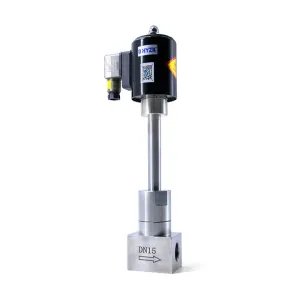
Cryogenic solenoid valve
Klasifikasi mereka: Solenoid ValveTampilan: 573Nomor:Waktu rilis: 2026-10-23 15:36:20Nominal Diameter: DN6~25
Applicable Media: Liquid nitrogen, liquid oxygen, liquid hydrogen, liquefied natural gas, and other cryogenic media
Applicable Pressure: 0~1.6MPa, 0~2.5MPa, 0~4.0MPa, 0~4.0MPa
Berita
Kategori:
Tidak ada hasil pencarian!
Kasus
Kategori:
Tidak ada hasil pencarian!
Video
Kategori:
Tidak ada hasil pencarian!
Download
Kategori:
Tidak ada hasil pencarian!
Rekrutmen
Kategori:
Tidak ada hasil pencarian!
Produk yang direkomendasikan
Tidak ada hasil pencarian!



 ada apa
 Telepon